Monday, April 27, 2009

Woden Cemetery


On a recent trip to Canberra, we visited Woden Cemetery. See this map for the exact location. It is a rather beautifully set out cemetery, fan like in its layout.

History

"Opened in 1936 and closed in 1979. The Cemetery was re-opened in March 1999. This formally planned cemetery features many stately mature trees and offers lawn and monumental burial sites in different religious and general areas." Source

and this....

"Woden Cemetery was Canberra's first public cemetery, opening in January 1936 as a denominational cemetery. The plan included the provision of areas for special buildings at a later date and the cemetery was designed to both reflect our heritage and allow for future enhancement of the landscaped gardens. It is a formally planned, open park style cemetery with many stately mature trees and lawn and monumental burial sites in different religious and general areas.

Woden Cemetery was closed in August 1979 except for burials for which reservations are held. The cemetery was re-opened in March 1999. In 1992 Memorial Gardens for interment of ashes and an ex-Service section were added. An enclosed mausoleum, called Christ the Redeemer Mausoleum, for burial in 304 above ground vaults was completed in 2001.

A Garden of Remembrance opened in 2005, for official commemoration of war veterans where it cannot be provided at the gravesite or crematorium. In a uniquely Australian concept, eligible war veterans are permanently commemorated using individual bronze plaques mounted on walls in a landscaped garden. Previously, most of the veterans from the ACT and surrounding districts were commemorated at the NSW Garden of Remembrance in Rookwood, Sydney, but the majority of those plaques have now been transferred to Canberra. The Garden also features a visitor pavilion, seating and symbolic artwork.

While the majority of burials are of Canberrans, ashes and memorial plaques represent people from as far south as Eden and as far north as Goulburn.,Woden Cemetery forms part of the Woden Town Park." Source

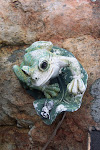
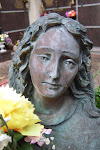
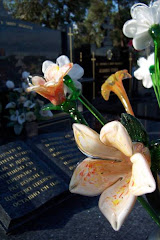
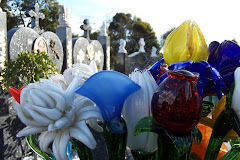
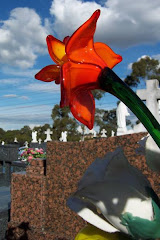
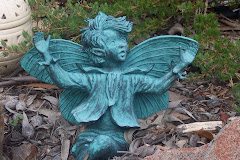
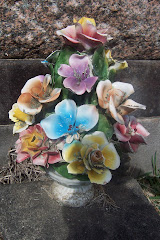
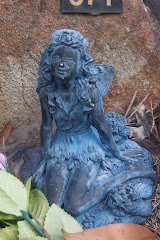
I have included a selection of photographs but more will be available when we can get around to uploading this and two other collections - Liverpool General Cemetery and St Peters Anglican Church cemetery. When these are online I will include a short piece on each.

Monday, October 13, 2008

Macquarie Park Cemetery and Crematorium


This large cemetery contained some very interesting sites including a large number of Asian graves (we found a stash of "Hell money" at one of the sites) a number of single raised crypts and a rather intriguing "Station of the Cross" walk...more on that later. It is beautifully laid out and contains a lovely mix of the old and the new.

The Macquarie Park Cemetery and Crematorium is located in North Ryde. Here is a map of the grounds.

The website for the cemetery is rather odd. The first page has postcards of sorts with different people coupled with phrases such as, "Look after my grandma". I am not sure what purpose they serve but I thought it rather odd.
However, I thought this message on the website was particularly interesting:
"Families wishing to release Ballons or Doves should contact:
Civil Aviation Safety Authority
Sydney Region, Bankstown
Phone: (02) 9780 3007"

A Brief History of the Site

"The cemetery comprising approximately 160 acres was dedicated in 1902 to be known as Northern Suburbs General Cemetery Trust. It is owned by the NSW Government and operated under the Trusteeship of Honorary Trust Board members.

The first Trust appointed in 1921 comprised Rev J G M Taylor and Messrs
C B Thistlewaite, G Chalmers and A J Hare and as was the custom in those days the cemetery was divided into various denominational areas.

The first burial took place on 20 April 1922 Henry Mashman, in the Church of England area (G1 Grave No. 5.)" (Taken from website)

Sunday, September 14, 2008

Randwick General Cemetery

The first thing that struck me in this cemetery was the amount of grave desecration. Apart from bottles, plastic bags and other rubbish around the graves, the headstones and various adornments we often broken or completely destroyed. After hunting for some good and unusual pieces I had to take cover the in the mausoleums after being swooped numerous times by a rather territorial magpie. I managed to get some good shots, and have included these on the picture collection to the right of the posts.

Some information about Randwick Cemetery:

"Until January 1871 (when it was closed) the main cemetery for the Randwick area was at St Jude's Church. After that date, residents went to Rookwood, (then called Haslems Creek), Cemetery. In December, 1871 a petition from residents requested that Council "take necessary steps to secure a Cemetery for the residents of this neighbourhood." The petition went on to state that burials at Haslems Creek were "entirely unsuited to the requirements of this district." This twelve month delay shows that, although residents were prepared to trial Haslems Creek, some problem, (probably either cost or travel problems), made this cemetery inconvenient.

Simeon Pearce, at the same meeting, proposed a motion (which was carried), that the Mayor, Alderman Walter Bradley, approach the Minister for Lands, requesting him to "dedicate certain lands for a cemetery... and to arrange what settlement for the land they may deem correct." However, at the following meeting, on 20 December 1871, Pearce successfully proposed that the Council ask to purchase land in the Parish of Botany on the Long Bay Road (now Malabar Road). These two sections were in a little valley facing south with the drainage towards Maroubra Beach.

The request to the Government for the land took a year to be answered. Approval was finally given for Council to purchase the land for a cemetery on 4 December, 1872 at a cost of 45/12/6 pounds. Over one year had passed since the petition from Randwick residents was first presented to Council.

Another nineteen months were to pass before the cemetery approached the stage of being used. During that time, the Cemetery By-Laws were adopted by Council on 8 January 1873. It took the Government another three months to approve these regulations."


Taken from A History of Randwick Cemetery (Randwick Council)

Sunday, August 24, 2008

Frenchs Forest Bushland Cemetery


Today we ventured out to Frenchs Forest Bushland Cemetery after having a great yoga session and yummy brunch with friends (thanks Mary & Dan). We traveled ALL the way over to the North shore and found this little cemetery on the outskirts of the Garigal National Park


Taken from the official website:

Brief History
"The Frenchs Forest Bushland Cemetery occupies an area of 22 hectares (54 acres) of typical Hawkesbury Sandstone Bushland. On the 23rd January 1932, the Metropolitan Lands Department gazetted the site and officially dedicated it on the 8th October 1937 with the first burial taking place on the 24th April 1940. The Anglican Archbishop of Sydney, Most Reverend HWK Mowll, consecrated the Cemetery on the 20th February 1955.
Up to 1990 the Cemetery was known as The Frenchs Forest General Cemetery, the change to the present name being adopted to reflect the Bushland theme."


Most of the pictures will be up soon, but here is a small taster of some of the interesting things we found...

Friday, July 11, 2008

Gore Hill Memorial Park


It was a glorious day today and so after a lovely brunch with friends in Surry Hills, I ventured
over the bridge to Gore Hill Cemetery (now Memorial Park). Some details about the site:


"Originally dedicated on 19 May 1868, the Cemetery covers around 5.7 hectares. The first known burial was in 1877 but earlier monuments are to be found, transferred here from Devonshire Street Cemetery. Planned as a formal Victorian-Edwardian landscape garden, and enclosed by mature evergreen trees, the Cemetery exhibits a wide variety of plantings and many fine examples of the stonemason’s art. The Cemetery was closed to burials in 1974. A Memorial Garden for the placement of ashes was established in 1991. The site was declared an historic cemetery in 1986 and is listed on the State Heritage Register." Taken from Willoughby City Council website.


There is no wikipedia entry on this site, so I think I might do a little digging to see what I can find on this place. My main focus today was on merging the living plants with the stone gravestones. Flowers of many colours were out and their vibrancy compared well with the hard stone. I have included 10 of my favourite pictures on this post - and more will be able to be seen when the rest have been uploaded.


There were lots of little paths, brick paved, grassy and those trodden out by footsteps seeking those lost gravestones near the end of the park. As the park is right opposite the North Shore Hospital, I suspect many workers and perhaps patients might find themselves wandering around there on a sunny day. Certainly I saw a number of amblers today.

Sunday, May 25, 2008

St Judes Anglican Church Cemetery


I dragged my partner out of the house yesterday afternoon to go and visit the very small cemetery located at the back of St Judes Anglican Church in Randwick. This heritage listed church and cemetery contains a number of ornate headstones and monuments.


I thought that they cemetery had closed its gates to new burials but found one from 2007 inside. Historical information is scarely available on the internet about this burial ground but books available at the Randwick library and my own school library will fill out the story. I will add to this entry soon. In the meantime here are some selected photos. As always, you can see the rest of the photographic collection from the link on the right.


Sunday, April 27, 2008

The Prince Henry (Coast) Hospital Cemetery (Little Bay - Botany National Park)


A hospital was established at Little Bay in 1881 after an outbreak of smallpox in the inner suburbs of Sydney. It was established in this location as it was deemed far enough away from the main centre to ensure that the infectious disease would spread. This quarantined site soon became the recipient of all infectious disease cases in Sydney including those suffering from typhoid fever, bubonic plague and leprosy. The cemetery was established soon after to house the patients who succumbed to these diseases.


Over 2000 people were buried in the cemetery. However, many of the headstones have not survived, many are undesc, but each headstone has been fully transcribed if possible, and of course, some of the people who were buried there would never have had a headstone in the first place.

Source: Cape Banks Family History Society Inc

Tuesday, April 22, 2008

Eastern Suburbs Memorial Park (update)


I took advantage of the relatively sunny afternoon to head back to get some more photographs at this site and to see the Pioneer Memorial Park. Headstones and bodies were moved here after the closure of the Old Burial Grounds in Sydney central. I found some interesting pieces on the graves including a tin of herring. Other interesting items included an electric lamp in the shape of the nativity scene and a ceramic Mary. The design of the gardens is quite beautiful with a waterfall and pond dividing a part of the grounds. The above ground vaults are quite extraordinary and ornate and house some beautiful statues in the areas set aside for contemplation. More photographs available here.

Monday, April 21, 2008

Wikipedia entry

I used some of the information in my blog and some personal photographs to create a wikipedia page for Camperdown Cemetery.

Sunday, April 20, 2008

Camperdown Cemetery (Newtown, NSW)

I really need to go through my photographic collection systematically and write a little about each one I have visited. I aim to provide links to present and historical information, photographs, links to library resources, maps and other useful information. First one to be tackled is Camperdown Cemetery in Newtown.

Camperdown Cemetery History (so far)

About 18,000 people have been buried in the (once large) cemetery which was consecrated in 1849. Some of the old headstones were repositioned around the stone walls of the current cemetery. Burials ceased in the 1940s (Morgan, 1998)

There are a number of famous people buried there including Sir Thomas Mitchell, the explorer and surveyor-general of NSW (Webster, 2007). Also Eliza Donnithorne, who is believed to have been the inspiration for Miss Havisham in Great Expectations. An interesting story accompanies this lady. Apparently, "after her groom failed to turn up for their wedding breakfast, she left the breakfast on the table until the day she died. Charles Dickens heard about her from her neighbour, his friend Caroline Chisholm" (Webster, 2007). In December 2004 her grave headstone was smashed into 3 pieces. Peter Rodgers (then St Stephen's Anglican Church minister) requested funds to repair the headstone (and reinstate the original gates). The Newtown community came out to assist, ""We've received support from dog walkers, the gothic community, local residents coming in and people ringing up from all over the place...We also got funding from the Dickens Society." (The Glebe, 2004). The grave was repaired by The National Trust of Australia, Rookwood Anglican Cemetery and students from TAFE students as part of their monumental repair and maintenance course (The Glebe, 2004).

However, the famous shared the space with the less well known. One plaque reads: "In memory of the many humble, undistinguished, unknown, unremembered folk buried in this cemetery whose names are not written in the book of history, but are written in the book of life." (Webster, 2007) The cemetery is also home to 22 of the passengers aboard the Dunbar, the ship that sank off South Head in 1857 on a return voyage from England, killing 121 passengers. A special altar contains the remains.

There are also reports of ghosts in the cemetery; two in particular. "Bathsheba Ghost", a matron of the Sydney Infirmary, was buried there in 1868. Some locals also believe the wife of Sydney harbourmaster Thomas Watson - after whom Watson's Bay is named - occupies corner of the graveyard in search of her lover (Morgan, 1998)

After a murder in 1946, much of the original 4.8 hectare cemetery was turned into a public park. Four acres were set aside for the cemetery and the headstones from the park were relocated.
"What most people don't know," says Ms Ward, "is they didn't move the bodies, they just moved the headstones. Throughout Camperdown Memorial Park the bodies are still there under the park." (SMH, October 6, 2007)

Books

The darker side of Newtown and surrounds : a self guided tour for the misguided / National Trust of Australia

Self guided tour of Camperdown Cemetery / Camperdown Cemetery Trust

Historic Camperdown / by the Rev. T. G. Rees.

Online Articles

It was murder and mayhem in old Newtown

Websites

Camperdown Cemetery (Sydney Distance Education High School in conjunction with Camperdown Cemetery Trust)
Camperdown Cemetery (Sydney Webcam)

Photographs

My photographs
Camperdown Cemetery Restoration Project
Old Historical Camperdown Cemetery 1 (State Library of Victoria)
Old Historical Camperdown Cemetery 2 (State Library of Victoria)
Old Historical Camperdown Cemetery 3 (State Library of Victoria)
Old Historical Camperdown Cemetery 4 (State Library of Victoria)
St Stephen's Church - Camperdown Cemetery (State Library of Victoria)
Plaque to the humble residents (Sydney Distance Education High School)

References

Morgan, J (1998) " Lay A Ghost As You Picnic", Sydney Morning Herald, 17 October 1998. Retrieved, April 20, 2008 from Factiva Database.

Sydney Distance Education High School (2003) Camperdown Cemetery. Retrieved April 20, 2008 from http://www.ssdec.nsw.edu.au/history/camperdown/

Webster, S (2007) "It's a grave grave world", Sun Herald , 21 January 2007. Retrieved April 20, 2008 from Factiva Database.

Historic Grave Wrecked (2004) The Glebe, 1 November 2004, Retrieved, April 20, 2008 from Factiva Database.

"It was mayhem and murder in old Newtown" (2007) Sydney Morning Herald. Retrieved April 20, 2008 from http://www.smh.com.au/articles/2007/10/05/1191091364643.html