Thursday, January 7, 2010

Kojonup Cemetery

Konjonup is located 260km  from Perth. I wanted to visit this place as my great grandmother and great grandfather are buried here. I managed to find the grave after consulting the friendly and helpful staff at the local tourist information centre. 

Konjonup Cemetery


  This is the gravestone of my great grandparents. The inscription reads:
In Loving Memory of George Emery Gare
Beloved Husband of Henrietta
Loved father of Frank, Joan and Dick.
Born 1.9.1880   Died 28.4.1949


Later, when my great grandmother died, my grandfather (Frank Ellis Gare 1918-2003) 
interred her ashes in the same grave and provided the additional inscription (see image). 

The inscription reads:
And his loving wife
Henrietta
Born 11.3.1894   Died 2.9.1990
Together Again.  


I was not able to locate much information on the internet, save for this link to the record of the cemetery under the Kojonup Cemetery Act of 1928.


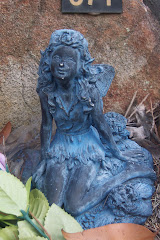
I like the effect of the spider web on this angel's head and wings.

 
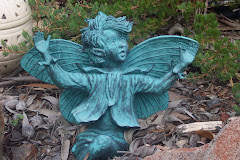
Someone has given this angel a flag to hold, rather unceremoniously held together with masking tape.

Wednesday, January 6, 2010

Wagin Cemetery

Wagin is located 229 km of Perth. We only stopped here briefly on our way back to Perth, hence the small number of photographs.

I could not locate any online information about this particular cemetery.

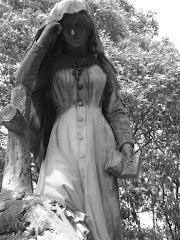
 The blue sky contrasts so well with the white angel in this shot.


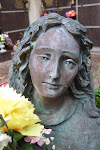
This is a rather disturbing find. The child looks so agonised, but beautiful surrounded by flowers. 


I love the singing trio. The red dust gives a real outback feel to this picture.


Friday, November 20, 2009

Death - The Last Taboo - The Australian Museum

Death - The Last Taboo

Throughout the world, death and the rituals that surround it are steeped in taboos. Death is celebrated, embraced and feared. Around death and the dead, cultures put in place diverse restrictions and practices associated with clothing, food and ritual. This section of the Australian Museum website explores what happens to us when we die and the different ways we deal with death.

Monday, October 26, 2009

What we leave with the dead and why....and more

Podcast from Thinking Allowed (BBC)

Laurie Taylor finds out about what we leave with the dead and why.

"From clothes to jewellery, photographs, hats, eye glasses, walking sticks, letters and even food, alcohol and tobacco, the objects mourners leave in the coffins and caskets of their loved ones tells us a huge amount about our attitudes to death and the rituals it involves.

Laurie talks to Sheila Harper, sociologist at the Centre for Death and Society at the University of Bath, whose new study about 'modern-day grave goods' uncovers the fascinating, touching and often moving examples of our gifts to the dead and why the objects we leave today are remarkably similar to the kinds of items uncovered by archaeologists in graves going back thousand of years.

Duncan Sayer, archaeologist from the Centre for Death and Society, discusses how human society has buried their dead.

Sheila Harper is an associate at the Centre for Death and Society at the University of Bath. Her PhD research focused on how mourners view the recently dead (in funeral establishments) and the ancient dead (in museums) in England and the United States. Sheila is also the Editorial Assistant for Mortality.

Paper: ‘I’m Glad She Has Her Glasses On. That Really Makes the Difference’ Grave Goods and Identity
By Sheila Harper

Duncan Sayer has PhD in Archaeology from the University of Reading. He has been a visiting lecturer at the Universities of Reading and Chester and is currently an associate lecturer at the University of Bath’s Centre for Death and Society."

Mortuary Practice and Social Identities in the Middle Ages
Sayer, D & Williams, H. (eds)
Publisher: University of Exeter Press
ISBN-10: 0859898318
ISBN-13: 978-0859898317


Have a listen

Thursday, July 23, 2009

Glass Flower Collection

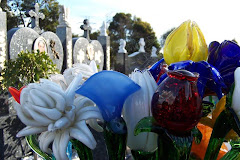
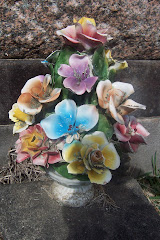
On my recent (re)visit to Rookwood Cemetery I noted in the Macedonian section of the park a recurring them in terms of flora decoration. The glass flowers came in all shapes, sizes and colours and were particularly beautiful additions to the plots. I took a number of pictures of these which can be seen either in the picture gallery on the right or at here.

New additions


News
I have added some new (old) pictures to the photographic collection including Belgrade New Cemetery and some new photographs from my recent return visit to Rookwood Cemetery.

Recent Visits
Today I went out to revisit Waverley Cemetery and found some really amazing statues, headstones and inscriptions. See my selection below - the full photographic collection will go up as soon as my partner processes them!

Sunday, May 10, 2009

Pinegrove Memorial Park


On the last day of the school holidays I decided to stop programming lessons for Term 2 and go out to take some more photographs. The journey to PineGrove Memorial Park took about 45 minutes on the way there, and about 75 on the way back (did not think of peak hour traffic!). It was a rather strange experience as it is a relatively new cemetery and has large tracks of unused land. The design is interesting, especially the specially designed Asian burial grounds completed with Lion gates. It is not as inviting as other cemeteries however, perhaps because it is so new and rather 'artificial' in its presentation and variety of memorials..

I have included a selection of photographs from the day here, and have added the rest to the photographic collection (see navigation bar). they turned out better than I expected. I think this might have had something to do with the light - a cold day with bright light. Most of the pictures were taken between 3pm and 4.30pm.


Ps. I have uploaded the rest of the cemetery photographs from Canberra and other Sydney locations as well, finally.

Monday, April 27, 2009

Woden Cemetery


On a recent trip to Canberra, we visited Woden Cemetery. See this map for the exact location. It is a rather beautifully set out cemetery, fan like in its layout.

History

"Opened in 1936 and closed in 1979. The Cemetery was re-opened in March 1999. This formally planned cemetery features many stately mature trees and offers lawn and monumental burial sites in different religious and general areas." Source

and this....

"Woden Cemetery was Canberra's first public cemetery, opening in January 1936 as a denominational cemetery. The plan included the provision of areas for special buildings at a later date and the cemetery was designed to both reflect our heritage and allow for future enhancement of the landscaped gardens. It is a formally planned, open park style cemetery with many stately mature trees and lawn and monumental burial sites in different religious and general areas.

Woden Cemetery was closed in August 1979 except for burials for which reservations are held. The cemetery was re-opened in March 1999. In 1992 Memorial Gardens for interment of ashes and an ex-Service section were added. An enclosed mausoleum, called Christ the Redeemer Mausoleum, for burial in 304 above ground vaults was completed in 2001.

A Garden of Remembrance opened in 2005, for official commemoration of war veterans where it cannot be provided at the gravesite or crematorium. In a uniquely Australian concept, eligible war veterans are permanently commemorated using individual bronze plaques mounted on walls in a landscaped garden. Previously, most of the veterans from the ACT and surrounding districts were commemorated at the NSW Garden of Remembrance in Rookwood, Sydney, but the majority of those plaques have now been transferred to Canberra. The Garden also features a visitor pavilion, seating and symbolic artwork.

While the majority of burials are of Canberrans, ashes and memorial plaques represent people from as far south as Eden and as far north as Goulburn.,Woden Cemetery forms part of the Woden Town Park." Source

I have included a selection of photographs but more will be available when we can get around to uploading this and two other collections - Liverpool General Cemetery and St Peters Anglican Church cemetery. When these are online I will include a short piece on each.

Monday, October 13, 2008

Macquarie Park Cemetery and Crematorium


This large cemetery contained some very interesting sites including a large number of Asian graves (we found a stash of "Hell money" at one of the sites) a number of single raised crypts and a rather intriguing "Station of the Cross" walk...more on that later. It is beautifully laid out and contains a lovely mix of the old and the new.

The Macquarie Park Cemetery and Crematorium is located in North Ryde. Here is a map of the grounds.

The website for the cemetery is rather odd. The first page has postcards of sorts with different people coupled with phrases such as, "Look after my grandma". I am not sure what purpose they serve but I thought it rather odd.
However, I thought this message on the website was particularly interesting:
"Families wishing to release Ballons or Doves should contact:
Civil Aviation Safety Authority
Sydney Region, Bankstown
Phone: (02) 9780 3007"

A Brief History of the Site

"The cemetery comprising approximately 160 acres was dedicated in 1902 to be known as Northern Suburbs General Cemetery Trust. It is owned by the NSW Government and operated under the Trusteeship of Honorary Trust Board members.

The first Trust appointed in 1921 comprised Rev J G M Taylor and Messrs
C B Thistlewaite, G Chalmers and A J Hare and as was the custom in those days the cemetery was divided into various denominational areas.

The first burial took place on 20 April 1922 Henry Mashman, in the Church of England area (G1 Grave No. 5.)" (Taken from website)

Sunday, September 14, 2008

Randwick General Cemetery

The first thing that struck me in this cemetery was the amount of grave desecration. Apart from bottles, plastic bags and other rubbish around the graves, the headstones and various adornments we often broken or completely destroyed. After hunting for some good and unusual pieces I had to take cover the in the mausoleums after being swooped numerous times by a rather territorial magpie. I managed to get some good shots, and have included these on the picture collection to the right of the posts.

Some information about Randwick Cemetery:

"Until January 1871 (when it was closed) the main cemetery for the Randwick area was at St Jude's Church. After that date, residents went to Rookwood, (then called Haslems Creek), Cemetery. In December, 1871 a petition from residents requested that Council "take necessary steps to secure a Cemetery for the residents of this neighbourhood." The petition went on to state that burials at Haslems Creek were "entirely unsuited to the requirements of this district." This twelve month delay shows that, although residents were prepared to trial Haslems Creek, some problem, (probably either cost or travel problems), made this cemetery inconvenient.

Simeon Pearce, at the same meeting, proposed a motion (which was carried), that the Mayor, Alderman Walter Bradley, approach the Minister for Lands, requesting him to "dedicate certain lands for a cemetery... and to arrange what settlement for the land they may deem correct." However, at the following meeting, on 20 December 1871, Pearce successfully proposed that the Council ask to purchase land in the Parish of Botany on the Long Bay Road (now Malabar Road). These two sections were in a little valley facing south with the drainage towards Maroubra Beach.

The request to the Government for the land took a year to be answered. Approval was finally given for Council to purchase the land for a cemetery on 4 December, 1872 at a cost of 45/12/6 pounds. Over one year had passed since the petition from Randwick residents was first presented to Council.

Another nineteen months were to pass before the cemetery approached the stage of being used. During that time, the Cemetery By-Laws were adopted by Council on 8 January 1873. It took the Government another three months to approve these regulations."


Taken from A History of Randwick Cemetery (Randwick Council)